
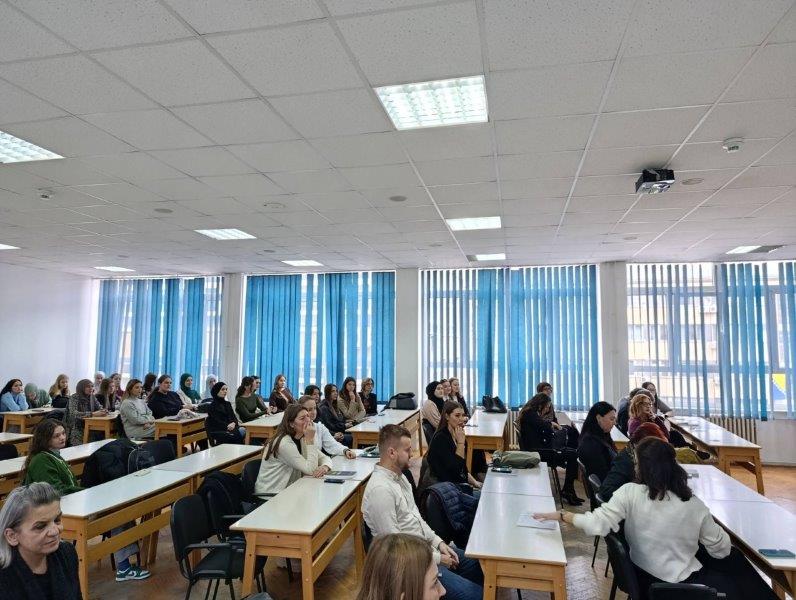
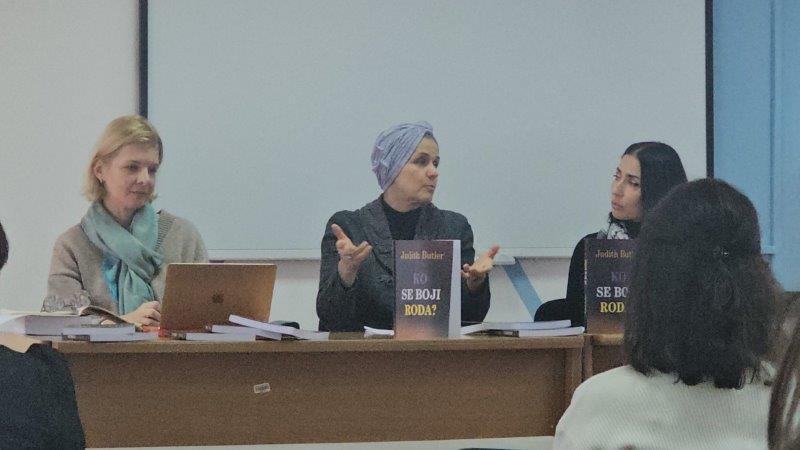
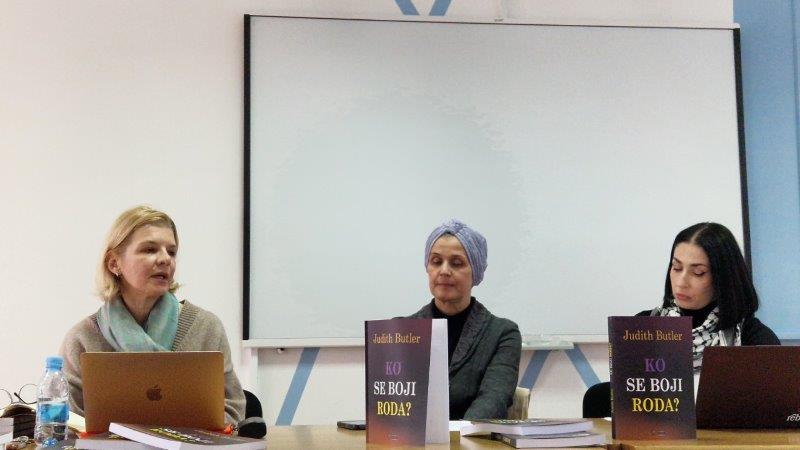
At the Faculty of Political Sciences of the University of Sarajevo, on December 9, 2025, the Twelfth promotion of the Bosnian edition of Who’s Afraid of Gender? by Judith Butler was held. The event took place within the international 16 Days of Activism Against Gender-Based Violence campaign, led by TPO Foundation and the UNIGEM network of universities from Bosnia and Herzegovina, Croatia, Serbia, and Montenegro.
The promoters of the event were Prof. Dr. Valida Repovac-Nikšić and Prof. Dr. Jasna Kovačević, while the moderator was Prof. Dr. Zilka Spahić Šiljak, the editor of the Bosnian edition.
Why is the translation of this book important?
In her opening remarks, the moderator emphasized that translating Butler’s book into Bosnian represents a significant step forward for both the academic community and the broader public in the region. This translation opens space for critically understanding contemporary anti-gender politics. Wherever theory is removed from the public sphere—whether by labeling or by banning—the possibility of debate is eliminated, and instead of dialogue, only one ‘truth’ remains, imposed by states, institutions, or other powerful actors.
It was further highlighted that the book is valuable because it reveals how ignorance is used as a method of political action, how debates are avoided, distorted, and turned into a mechanism of symbolic violence. This resonates strongly in societies like ours, where the long-established practice of labeling critical intellectuals as “traitors” coexists with the elevation of ethno-national myths to the status of unquestionable truths.
Prof. Dr. Jasna Kovačević stressed that Butler convincingly shows how anti-gender movements do not arise out of concern for tradition or morality, but from deep identity insecurity in conditions of social and economic crisis.
Kovačević asked whether the panic around gender actually redirects attention from economic injustices, corruption, and social insecurity onto the bodies of women and LGBTIQ persons.
In doing so, she opened the discussion on the idea of a “fantasmatic enemy”—the construction of gender as a threat to the survival of the nation, the family, or the so-called “natural order.” In such narratives, gender becomes an object of fear used to mobilize the masses and reinforce authoritarian moralities.
Another important point was the claim that anti-gender campaigns operate primarily through affects—fear, disgust, panic, moral alarm—while rational arguments play almost no role. The discussion raised the difficult question of how intellectual work and education can respond to politics that feed on emotional effects rather than facts.
Prof. Dr. Valida Repovac-Nikšić emphasized that political science refers to so-called wedge issues—topics used deliberately to polarize society and mobilize the electorate.
“Does ‘gender’ today function precisely as such an instrument?” she asked, pointing out that in many countries questions of sexuality, identity, and reproductive rights are used to divert attention from key issues such as corruption, economic inequality, and the collapse of public institutions.
In this context, anti-gender movements in the region become early indicators of authoritarian tendencies, even in countries that formally maintain democratic elections.
Repovac-Nikšić also referred to narratives in which gender is portrayed as a “foreign,” “colonial,” or “Western” idea:
“How is it possible that a basic concept of social science, discussed within European universities for more than half a century, is presented here as a threat to modernity and identity?”
These discourses, she noted, reflect unresolved tensions regarding Europe, modernity, and cultural integration: gender becomes a symbol of a broader societal anxiety toward change.
The promotion especially highlighted the systemic removal of theory and critical thinking from the public sphere. When gender, sexuality, reproduction, and identity are excluded from democratic debate and declared taboo, the very idea of political citizenship becomes diminished.
If discussing gender becomes “forbidden,” then it is impossible to discuss diversity, discrimination, inequality, or violence.
The promotion at the University of Sarajevo opened space for an exceptionally important dialogue on contemporary social crises, growing authoritarian tendencies, and the ways in which gender is instrumentalized as a political weapon.
Translations of books such as this one represent a crucial contribution to the regional struggle for knowledge, critical thinking, and social responsibility—especially at a time when ignorance, fear, and panic are used as mechanisms of political power.
