
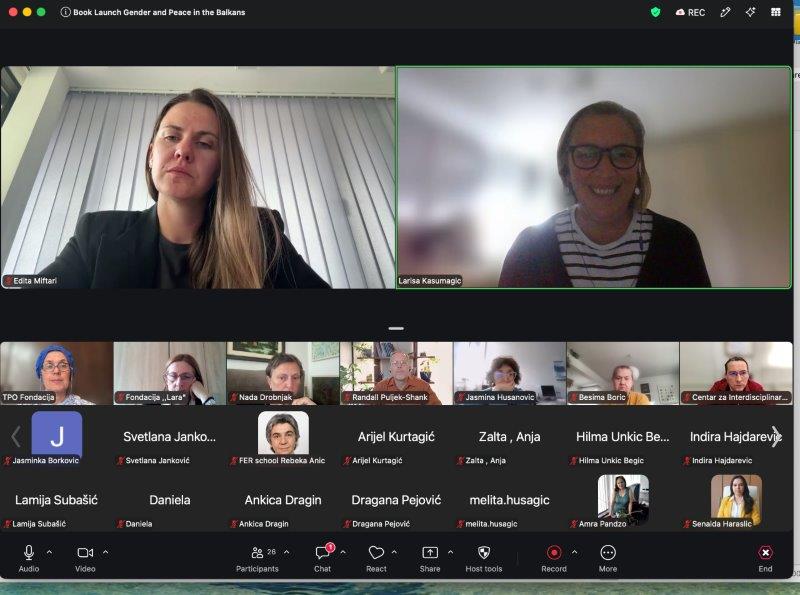
Peace is not something we achieve once and then simply possess. It is built every day through the way we speak, listen, remember, challenge injustice, and create space for others. This message marked the online promotion of the edited volume Gender and Peace in the Balkans: Sites of Challenges and Hopes, held on 23 September 2026, during the week commemorating the International Day of Peace. The event brought together Prof. Dr. Biljana Kašić, Prof. Dr. Larisa Kasumagić-Kafedžić, Prof. Dr. Zilka Spahić Šiljak, Dr. Randall Shank-Puljek, and Edita Miftari.
The volume emerged as a result of the Peace Conference “Gender and Peace in the Balkans,” held in February 2025 within the UNIGEM project. The conference brought together scholars and activists from the region and beyond to reflect on peace from a gender perspective, drawing on different disciplines and experiences. The publication demonstrates that peace is not built only at negotiation tables and within political institutions, but also in education, communities, families, religious spaces, cultures of memory, and everyday relationships.
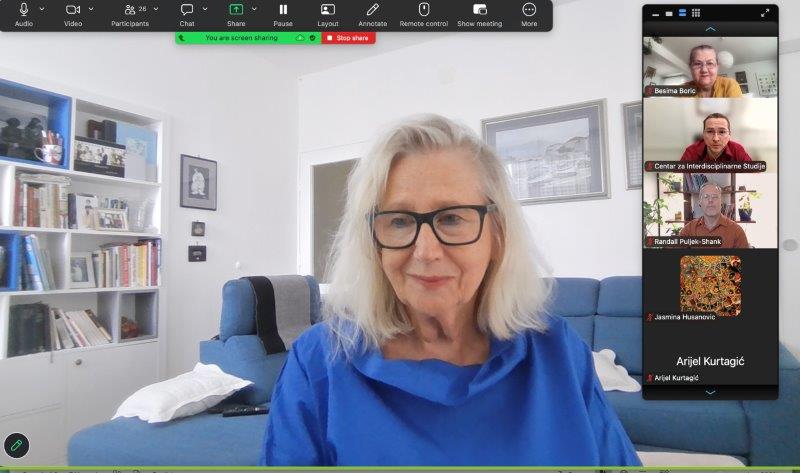
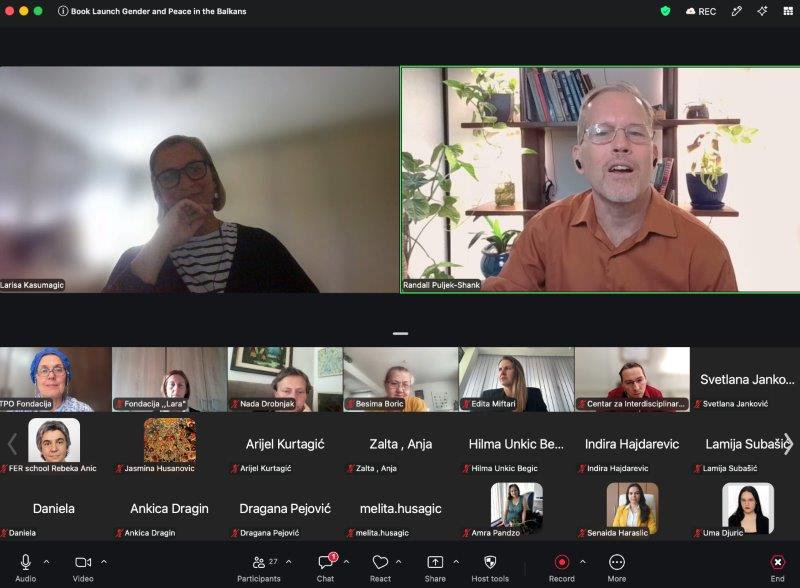
The editors of the volume, Prof. Dr. Biljana Kašić and Prof. Dr. Zilka Spahić Šiljak, brought together contributions that critically examine militarism, nationalism, the legacies of war, gender regimes, religion, language, memory, education, and different forms of feminist peacebuilding. The promotion therefore offered an opportunity not only to present the publication, but also to discuss a crucial question: what kind of peace do we need today, and who has the power to define it?
Speaking about the greatest challenges to peace in the Balkans, Prof. Dr. Larisa Kasumagić-Kafedžić warned about militant patriarchy, the normalization of the logic of war, and violent narratives that are penetrating educational systems and systems of values. She particularly highlighted the militarization of knowledge and the increasingly strong links between military industries, technology, and universities. In contrast, she identified “sites of hope” in the stories and practices of activism presented in the book, which show that peace is not a romanticized ideal, but a continuous process that requires ethical engagement, responsibility, and work within communities. Language, in this regard, is one of the key sites of struggle for peace. Language can produce divisions, enemies, and justifications for violence, but it can also become a space of resistance and of building different kinds of relationships.
Dr. Randall Shank-Puljek emphasized that a gender perspective allows us to see what traditional analyses of war and peace often leave invisible. Women’s contributions to peacebuilding frequently disappear from dominant historical narratives, public memory, and practices of memorialization. At the same time, militarism shapes much more than the military itself – it affects institutions, culture, language, and the ways in which we understand security and power. He also warned about the strength of contemporary anti-gender campaigns operating through well-connected transnational networks. This is precisely why the analysis of language and discourse, strongly represented in the volume, helps us recognize the spaces in which power is produced and normalized.
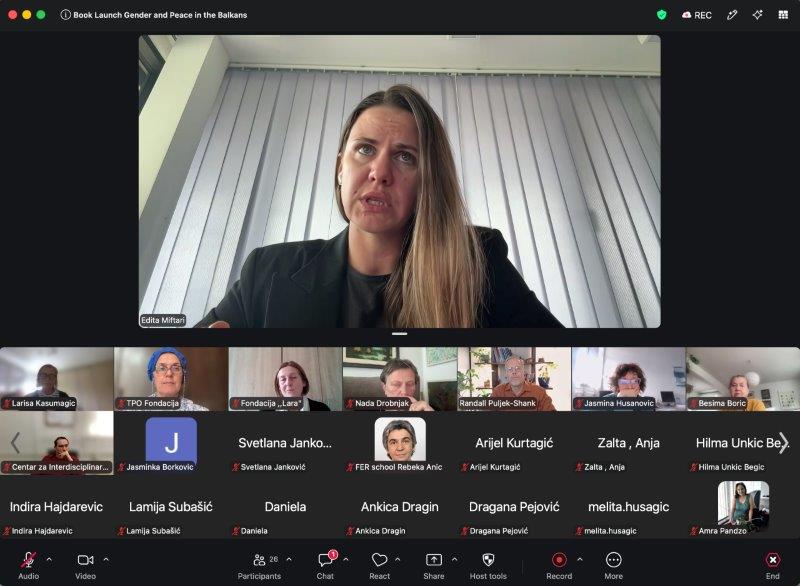
Speaking about feminist understandings of security, Edita Miftari from UN Women reminded the audience that the first question must be: whose security are we protecting, and from what? Today, security is too often measured by border control, military strength, and the amount of weaponry, even though military capacity is not the same as peace. A feminist perspective brings the concept of human security back to the centre and asks how much societies invest, before crises emerge, in violence prevention, education, social cohesion, and equality. A state may be militarily strong while large numbers of its citizens still feel insecure. Feminist reflection on peace therefore should not remain confined to academic debates, but must be reflected in concrete policies, budgets, and programmes.
Particular attention was devoted to the legacy of war and to the question of whether sustainable peace is possible without seriously confronting the past. Kasumagić-Kafedžić emphasized the transformative role of education, especially in societies where wartime traumas remain unprocessed and dominant ethnonational narratives suppress positive examples of peacebuilding or deny established facts about the war. The discussion also addressed the ambivalent role of religion in the Balkans. Religious institutions can reproduce patriarchal and national hierarchies, but faith and spirituality can also be powerful resources for peace engagement. The examples of interreligious feminist work presented in the volume demonstrate the need to move beyond a simple division between the “secular” and the “religious” and to create space for different alliances in peacebuilding.
Reflecting on more than 25 years of the Women, Peace and Security Agenda and UN Security Council Resolution 1325, Edita Miftari highlighted its significant contribution to legitimizing questions of women’s political participation, the gendered consequences of conflict, and sexual violence. Nevertheless, a major gap remains between women’s formal presence and their actual influence on decision-making. The Women, Peace and Security Agenda, it was emphasized, must not remain merely a normative framework – it must be grounded in the real needs and experiences of women.
Participants also warned about the loss of the peacebuilding infrastructure that has been developed in the Balkans over the past thirty years. Small women’s and peace organizations possess knowledge, trust, networks, and social capital that cannot simply be replaced by new short-term projects. It is precisely these organizations that have often sustained dialogue when institutional and political channels were closed. The promotion concluded with a call to renew dialogue between civil society, academia, political institutions, and religious institutions, particularly around issues that are the most difficult to discuss.
The volume Gender and Peace in the Balkans: Sites of Challenges and Hopes reminds us that there is no sustainable peace without gender justice, and no gender justice without transforming relations of power. Peace is not simply the absence of armed conflict. Peace means the presence of justice, dignity, and equality. For this reason, the publication is intended not only as an academic contribution, but also as an invitation to continue asking difficult questions, connecting knowledge and activism, and preserving spaces in which a different kind of peace can be imagined and built.
The volume is available on the TPO Foundation website.
